Hardware Product Engineering Studio
Hardware Engineering Built to Your Target Form, Quantity, and Budget Specifications.
Provide your core functional requirements and constraints. We identify the optimal engineering path — component sourcing, prototype validation, or mass production — and execute end-to-end circuit, firmware, and mechanical engineering.
Equipment temperature logger
Battery-powered temperature logger, case 18 mm high, 24 h runtime, 100 units, BLE.
Extracted requirements
- Power source · Internal battery
- Sensors · Temperature
- Enclosure height · 18 mm
- Continuous runtime · 24 h
- Target quantity · 100 pcs
Recommended delivery pathBuild a few first
2 · Structuring Requirements
Requirements Become Technical Specifications, Unconfirmed Parameters Turn into Engineering Reviews.
We analyze form factor, target volume, budget limits, and schedule to build an initial technical specification. Gaps are resolved through engineering reviews, and initial consultations are provided at no charge.
Requirements · Engineering model · Equipment temperature logger
Battery-powered temperature logger, case 18 mm high, 24 h runtime, 100 units, BLE.
- Form & functionTemperature · 18 mm
- Quantity100 pcs
- BudgetUnspecified
- TimingUnspecified
Engineering Spec (PRD)
Confirmed 6Inferred 0Unspecified 7
- SensorsTemperatureRead from your text
- Power sourceInternal batteryRead from your text
- Continuous runtime24 hRead from your text
- Wireless connectivityBLE (Bluetooth Low Energy)Read from your text
- Enclosure height18 mmRead from your text
- Target quantity100 pcsRead from your text
- Cost or features firstUnspecifiedNot decided yet
- When you need itUnspecifiedNot decided yet
Review and edit all 13 specifications
- Power sourceInternal batteryRead from your text · User-requested condition
- Enclosure height18 mmRead from your text · User-requested condition
- Enclosure widthNeeds checkNot decided yet
- Enclosure depthNeeds checkNot decided yet
- Continuous runtime24 hRead from your text · Illustrative value
- Target quantity100 pcsRead from your text · Illustrative value
- Wireless connectivityBLE (Bluetooth Low Energy)Read from your text · Illustrative value
- SensorsTemperatureRead from your text · Illustrative value
- Operating environmentNeeds checkNot decided yet
- Design statusNeeds checkNot decided yet
- PurposeNeeds checkNot decided yet
- Cost or features firstNeeds checkNot decided yet
- When you need itNeeds checkNot decided yet
Algorithm-generated preliminary draft. A dedicated engineer verifies technical feasibility upon project consultation.
Detailed Specification Review3 · Physical Architecture Review
Component Mapping and 3D Assembly Engineered from Your Specifications
Inspect how each specification line item maps to physical electronic and mechanical components. Interact with the device and examine internal fit via the exploded assembly view.
- Form & functionTemperature · 18 mm
- Quantity100 pcs
- BudgetUnspecified
- TimingUnspecified
 Example illustration
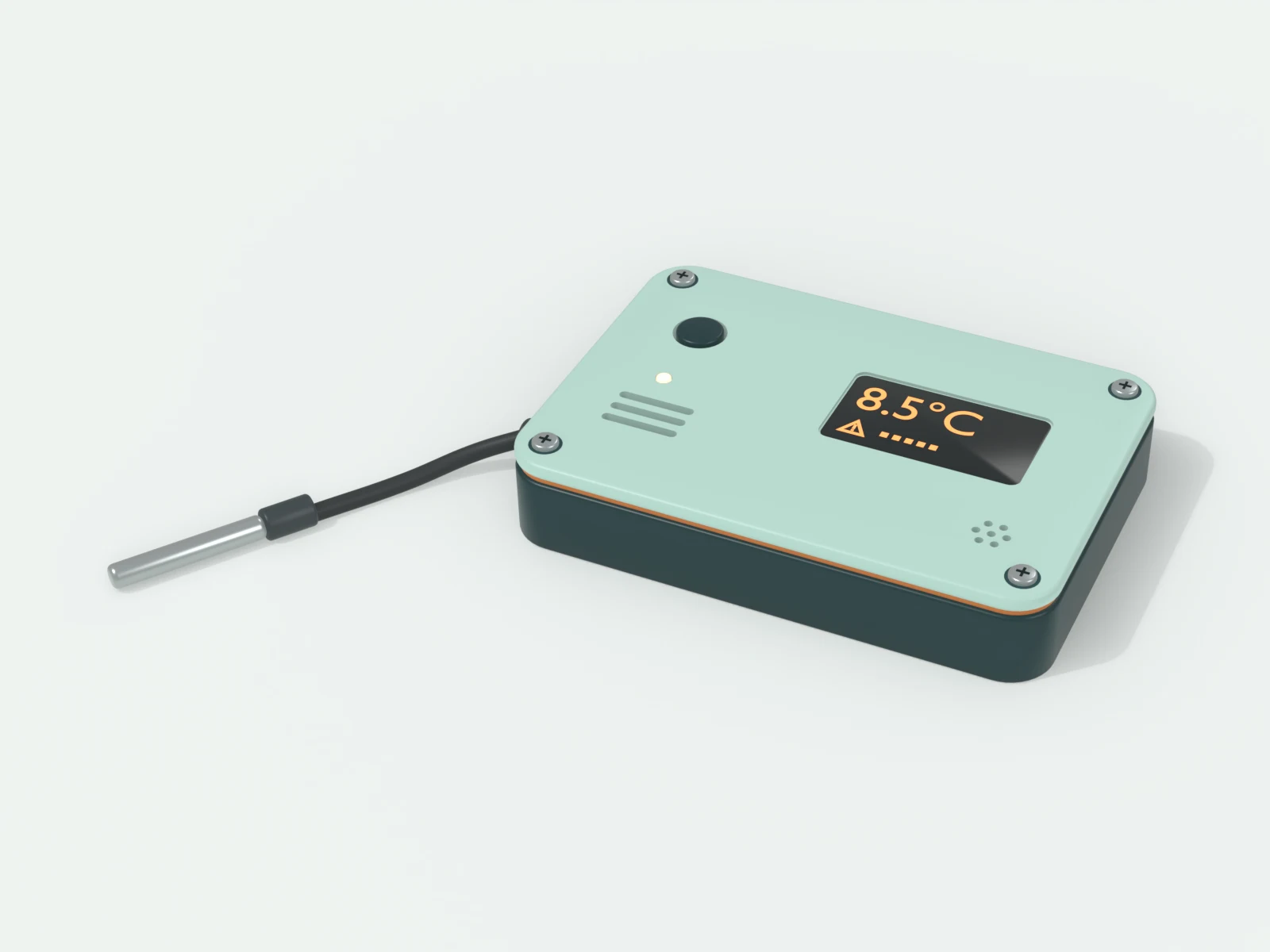
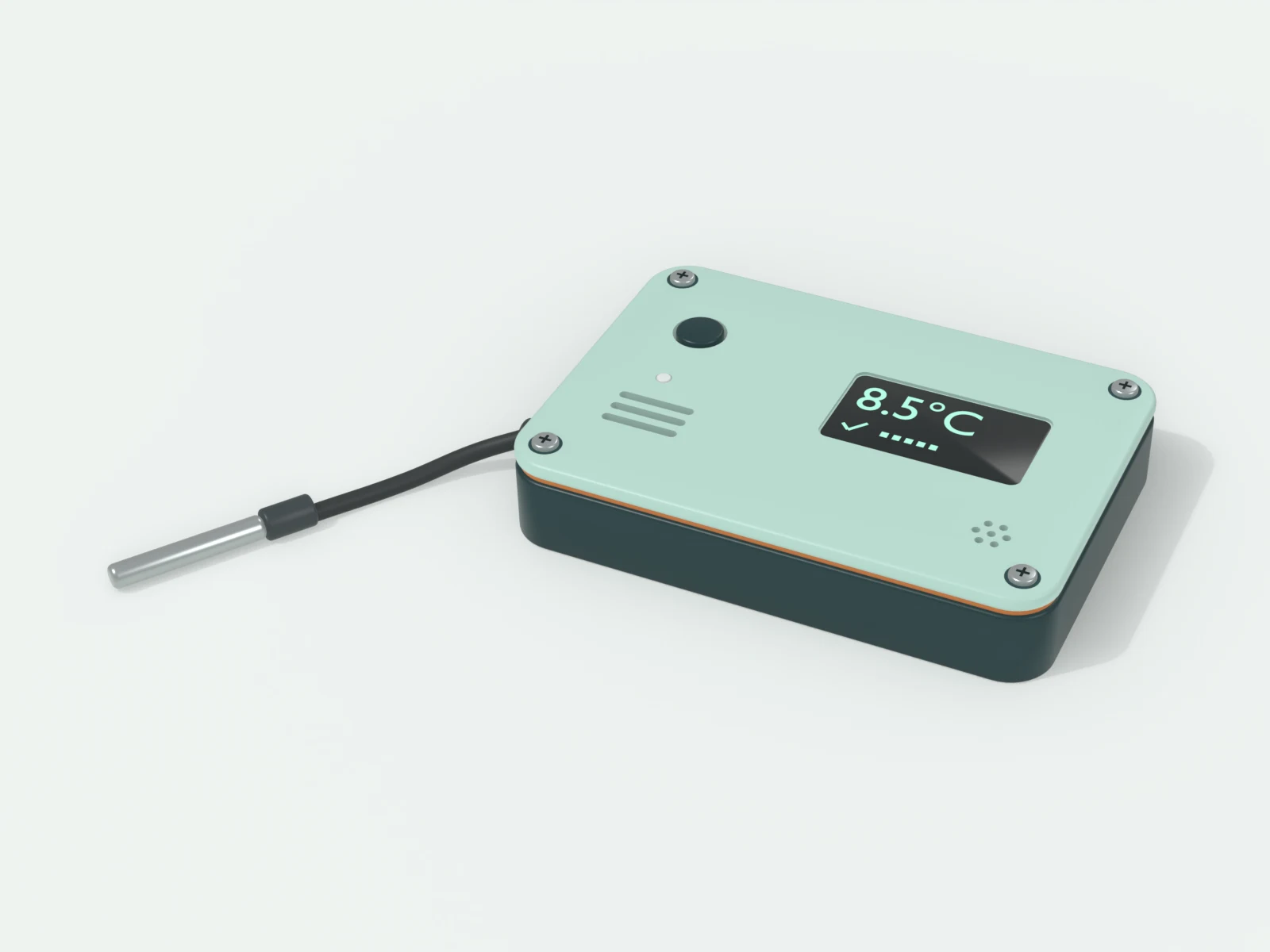
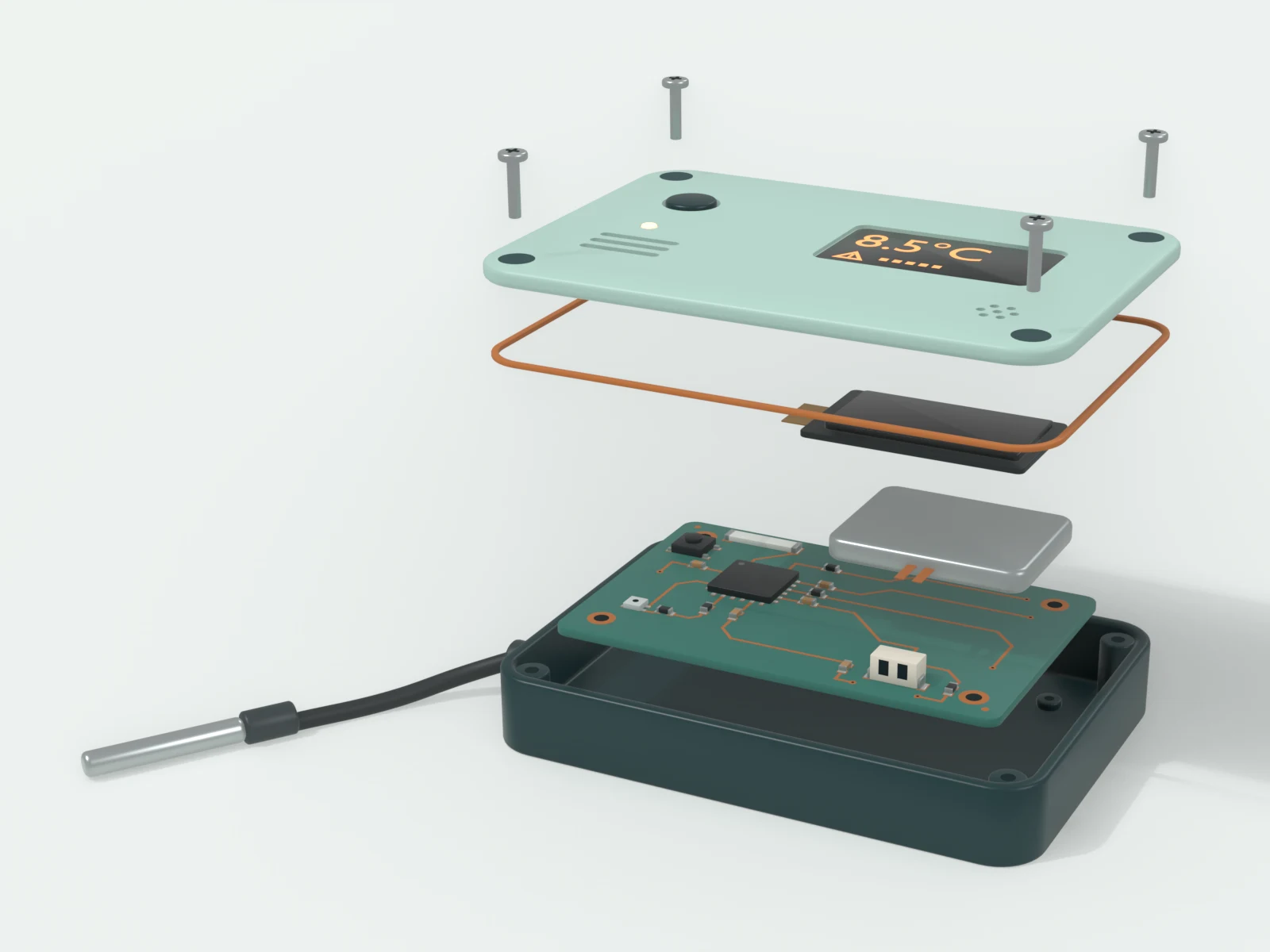
- Temperature ProbePrecision sensing element inserted into monitoring zoneTechnical Specifications Sensors Temperature
- Slim Enclosure (18mm)Ultra-slim form factor engineered for restricted spacesTechnical Specifications Enclosure height 18 mm
- Display PanelDisplays real-time temperature and system status
- Alarm LEDFlashes high-visibility visual alert on threshold breach
- Piezo BuzzerEmits audible sound alert during fault condition
- Tactile SwitchTactile user input to acknowledge active alarm
Simulated model for system architecture evaluation. Screen readouts are rule-based emulations.
4 · Optimal Delivery Path
Optimal Hardware Delivery Path Tailored to Volume, Timeline & Budget
We analyze target manufacturing volume, timeline constraints, and existing design assets to recommend the most cost-effective path.
- Form & functionTemperature · 18 mm
- Quantity100 pcs
- BudgetUnspecified
- TimingUnspecified
Unique form factor and power requirements necessitate building working prototypes (1–10 units) to validate physical fit.
Undecided → Consult with Hardware EngineersUnit Cost Index
Production Quantity
Example cost curve (single prototype unit = 100 index · not a quote)
| New Build Unit Cost · Production Quantity 1 | 100 |
|---|---|
| New Build Unit Cost · Production Quantity 2 | 80 |
| New Build Unit Cost · Production Quantity 5 | 67 |
| New Build Unit Cost · Production Quantity 10 | 66 |
| New Build Unit Cost · Production Quantity 20 | 58 |
| New Build Unit Cost · Production Quantity 50 | 53 |
| New Build Unit Cost · Production Quantity 100 | 51 |
| New Build Unit Cost · Production Quantity 200 | 47 |
| New Build Unit Cost · Production Quantity 500 | 42 |
| New Build Unit Cost · Production Quantity 1,000 | 30 |
| New Build Unit Cost · Production Quantity 2,000 | 26 |
| New Build Unit Cost · Production Quantity 5,000 | 25 |
| Your condition: 100 | 100 |
At 100 units, one unit costs about 51% of making just one.
Off-the-shelf adaptation and sourcing follow commercial hardware distribution pricing.
5 · Phased Execution & Deliverables
Milestone Verification and Formal Engineering Deliverables
We share interim results and check records at every milestone and proceed only upon your approval, reducing costly redesigns later.
- Form & functionTemperature · 18 mm
- Quantity100 pcs
- BudgetUnspecified
- TimingUnspecified
Typical Outsourced Development vs. Arcarix Integrated Engineering
Typical outsourcing starts from a client-prepared spec, and the first real check often comes with the physical prototype, when redesigns cost more. Arcarix refines the spec from the initial idea and reviews interim results at each milestone to reduce rework.
Typical outsourcing
- Spec drafting & quote waiting
- Contract engineer designs & builds
- First look at the assembled prototype
- ↺ Redesign and rebuild changes
- Delivery
Arcarix Integrated Engineering
- Requirements → spec + form & parts draft
- Mechanical–electrical boundary
- Circuit · PCB3D enclosureFirmware (dev kit)
- First integrated prototype (EVT)
- Revision · spec-line testing
- Deliverable handover
Milestone verification & approval checkpoint
- Start from just an idea
A spec or brief usually has to come first before a quote and schedule.
A sentence or two is enough for a draft spec; gaps become questions.
- Form and circuit designed together
Circuit and case are often designed separately and first meet when the prototype is assembled; problems then mean rebuilding.
Form, enclosure and circuit are designed together to the same dimensions from the start, with 3D fit checks and interim results at each step to reduce rebuilds.
- Start from set foundations
Parts and layout are chosen and drawn from scratch for each project.
We start from chip families we use often (ESP32, nRF52) and a set order of part and fit checks.
- Don’t build what already exists
A development request assumes something new is built.
If a product on the market works, we compare, check a sample and you receive it.
Planned An AI hardware engineering pipeline assisting firmware drafting and static compilation verification from PRD specifications
Structural example. Factory time, such as making boards and parts, is the same, and no timeline is promised. Real schedules are agreed with you from your conditions.
Active Engineering Path Build a few firstRecommended Path
Spec, Form & Key Parts TogetherComplete
Draft spec with form and internal layout uploaded. Please check size and screen and button positions.
Mechanical–Electrical BoundaryComplete
Boundary drawing with board outline, height limits and part positions uploaded.
Concurrent Circuit, Enclosure & Firmware DesignComplete
Schematic, PCB placement and 3D interference check uploaded. Firmware is running on the dev kit.
Deliverable Schematic and PCB files · BOM (bill of materials) · Firmware source · Enclosure files
First Integrated Prototype (EVT)Complete
First integrated build photos and bring-up log uploaded.
Revision & Spec-Line TestingComplete
Revision list and spec-line test records uploaded.
Deliverable 1–10 working prototypes · Test records per requirement · Use and maintenance guide
Verification of Functional Specifications
- ✓SensorsTemperature
- ✓Power sourceInternal battery
- ✓Continuous runtime24 h
- ✓Wireless connectivityBLE (Bluetooth Low Energy)
- ✓Enclosure height18 mm
Quantitative testbench mapped to PRD specifications
In form-driven products (wearables and the like) the enclosure sets the board area first; in spec-driven products (sensors, industrial devices) the case is shaped around the parts and battery. Either way, form and circuit move together from the start.
What you receive with this method · Build a few first
- 1–10 working prototypesMade in · Revision & Spec-Line Testing
- Test records per requirementMade in · Revision & Spec-Line Testing
- Schematic and PCB filesMade in · Concurrent Circuit, Enclosure & Firmware Design
- BOM (bill of materials)Made in · Concurrent Circuit, Enclosure & Firmware Design
- Firmware sourceMade in · Concurrent Circuit, Enclosure & Firmware Design
- Enclosure filesMade in · Concurrent Circuit, Enclosure & Firmware Design
- Use and maintenance guideMade in · Revision & Spec-Line Testing
Costs are broken down transparently by schematic design, PCB layout, BOM components, physical tooling, and testing.
Ownership of EDA schematics, Gerber artwork, and 3D CAD sources is formally defined in the project agreement.
Technical Consultation & Project Inquiry
Describe your hardware concept to begin.
Enter your requirements above to auto-generate a draft specification, or contact us directly.
Technical consultation & preliminary quote at no charge
Initial Information Required for Technical Consultation
- A sentence or two
What, where and why. No spec needed.
- A photo or sketch of where it goes
A hand drawing is fine.
- Roughly how many
Leave it blank if unsure.
- What can’t change
Size, power, budget or timing you can’t give up.
- Selected Delivery Path
- Undecided (decide with an engineer)
- Target quantity
- Needs check
- Design change review & decision
- Open · Compare options below
Rule-based example summary · Not a binding quote

Undecided (decide with an engineer)

If you have reference photos or hand sketches, please attach them directly in your mail app after opening the email draft.
When your mail app opens, check the message and press Send. It is delivered only then.
Please attach installation photos, mechanical sketches, or reference datasheets if available. If your mail client is not configured, copy the summary and email hello@arcarix.com directly.